
Atari Printers
Atari Printer Reviews...
THE ATARI 825 80 COLUMN PRINTER
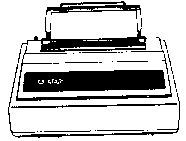
Based on the Centronics 737 quality dot matrix printer, the ATARI 825 is a very impressive device. Ideally suited to word-processing, business use, or a high-quality printer in the home, the 825 can produce three character sets and then an expanded version of each, for a total of six different types of characters. In the home it makes an ideal replacement for the typewriter, especially when combined with a word-processing system. The paper feed is both tractor and friction allowing you to use nearly any type of paper with precise control over your printing requirements.
Simple commands control the printing font (style of characters), whether or not you want underlining, and the foreward or reverse motion of the paper. An ('escape, escape, control Q' for example will print the 'SECONDARY CHARACTER SET'. You can easily combine two or more sets of characters on one line with one exception, and when you specify underlining, it is done the same time as the characters above it, not after.
The printhead distance from the paper can be adjusted by just flipping a lever, allowing you to print on thicker surfaces such as several carbon sheets or mailing labels. Paper can be sheet fed individually, fan-fold type, or on a roll. The paper rack on the back handles roll or glides fan-fold over it. Any of these can be pin fed or the friction rollers can handle at the top of a page, go to the bottom of that page, then return to the top again to print something next to the heading, and the printing will not be offset in any way.
Switches on the front of the 825 allow you to select from On-Line and Local permitting to manually advance or reverse the paper by using this in conjunction with the REV/FOR switch next to it. On the right is the on/off switch; the 825 cannot be on the same time as the 822 or 820; only one printer may be on at any given time or printout may not occur.
The high impact plastic cabinet of the 825 houses a micro-processor driven dot matrix driver with a continuous 'moebius' type ribbon, which at first look appears rather a strange setup. The ribbon is sort of bunched in a tray rather than spool driven giving the printer fewer parts to breakdown. The ribbon never need reverse direction; it rotates 180 degrees after the printhead and before if reaches the ribbon tray. So the next time it passes before the printhead the opposite side is used until it goes through a third time and it is flipped again. The 825 is a non-graphics printer, however there are rumors of a graphic chip allowing 825 owners to upgrade their printer to graphics capability. This and the rumored Screen Dump-er from ATARI should prove to be quite impressive (lets hope this isn't just a rumor). The 825 lists for $999.95 and includes the cable that attaches to the parallel port on the 850 interface module, and a 59 page user manual.
THE ATARI 820 40 COLUMN PRINTER
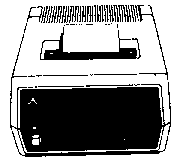
The ATARI 820 printer is a reliable, 40 column, dot matrix impact printer, capable of upper and lower case characters at a rate of 40 per second. In actuality, the 820's printer mechanism is from the Eaton 7000+ dot matrix printer. One thing which I found interesting is the fact that the 820 has virtually the same electronics as Atari's VCS. The same processor and PIA, with the PIA running the printer head instead of a television set. The main difference between the 820's electronics and the VCS board is the different ROM and the extra circuitry in the 820 to drive the printer head.
Before reviewing the 820, 1 wanted to put it through a very grueling workout. First, we decided to use the 820 for most of the long program listings in our last issue. However, the 820 printer comes standard with a blue ribbon (the type many grocery stores use in their registers) which doesn't reproduce well when reprinted or photocopied. Atari uses a 5/16 inch ribbon and recommends an Addressograph/Multigraph part number for replacement. Finding a 5/16 black ribbon was no easy task. I did however find a 5/16 ribbon which had to be transferred to the spool on the 820 (a messy job).During the first month of use, I managed to use the
roll of paper supplied with the printer, and except for the need of an occasional drop of oil on the print head guide shaft, the 820 performed Flawlessly. The standard 3 7/8 inch roll paper was much easier to find than the ribbon, and is readily available at most office supply or stationary stores. My only complaints during the first month of use was the noise (common with most dot matrix printers) and the automatic timeout cycle, which halts the printing for approximately three seconds to prevent overheating of the printer head. This pause occurs if the printer has been operating for long periods, and if taken into account, this pause changes the actual 40 cps speed of the 820.
I didn't feel as though this test proved the reliability or dependability of the 820, so we decided to use it on something a little more demanding. The mailing labels! Everyone thought that I was a little crazy when I decided to use the 820 for the labels but if this didn't burn the little sucker out, what would? I realize that the 820 wasn't made to be used with labels, but with 31/2 x 16/16 labels and a watchful eye I printed 90% of the labels used on our premiere issue. Surprisingly, it handled the task with very little problem.
Overall, if the noise or speed aren't a determining factor in your choice of printers, and you need a virtually trouble free 40 column printer, than the Atari 820 should fit your needs. The 820 lists for $449.95 and includes all necessary cables and user manual.
THE ATARI 822 THERMAL PRINTER
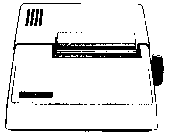
The first hardcopy device on my 800 was a Trend corn 100 thermal printer on which the ATARI 822 is based. Originally I had it output through a Macrotronics printer interface which includes a small subroutine I added onto Dos 1, so every time I booted up the 810 Disk Drive with DOS 1, the printer driver went in also. The small routine is required to redirect the 'P:' commands through the number 3 & 4 front controller ports rather than the serial port on the 800's right side. This worked fine Until I needed some sort of printout when using Compuserve. DOS 1 won't work with the Telelink I cartridge, so I couldn't use the Macrotronics interface system with the telecommunications setup. So I wired up the Trendcom to the parallel port on the 850 interface module, which needed some coercing to work properly. With help from Trendcom this was quickly solved using a .01 ceramic capacitor on the STROBE line in order to retime the signal (I would get double characters without the retiming: HELLO looked like this on the 100: HHEEELLOO).
When the 822 became available, the top on my 810 disk drive occupied by the Trendcom now became the resting place for the 822. When I first looked inside the 822, 1 thought 'Oh no!, it's missing half the parts, look at all the empty room compared to my Trendcom!'. I don't know how they did it, but the serial driven 822 has much fewer parts than the parallel 100. The printer is so quiet all you hear is the advancement of the paper. The 822 doesn't use ink of any sort, rather its' printing head consists of a heat-producing 'filament' about 3/8 inches square. The special heat sensitive paper darkens to the appearance of blue or black ink depending on which paper you use, and since no ink is used, the lettering won't smudge.The 822 is about the same size as the 410 recorder, and houses the thermal paper role inside the heavily constructed metal and plastic 2.5 inch high casing. Some of the nice features include the ability to see what's being printed almost immediately unlike the 820 ",here the printing takes place deep inside the Unit. The printhead is also bi-directional (it prints left-to-right, and then right-to-left if there are characters on the next line. The appearance of the print quality resembles that of a dotmatrix (like the 820), with a limit of 40 characters per line. The back panel has a 'clean' look to it, with provisions for the standard ATARI power block connector, on/off switch, and two ATARI serial connectors allowing you to daisy-chain your peripherals. When you take all this into consideration, plus the ability of the 822 to print graphics, it becomes the nicest allaround printer for the average home computer owner. The printer won't output the control graphic characters, but will do graphic plotting.
For the $449-95 price, I feel the printer is a prime choice for many users who require smooth, quiet, and reliable hardcopy.
Digitized by CyberRoach Publishing for CyberRoach’s Digital A.N.A.L.O.G. Archive; restored here with permission.