Of course, the first issue that surfaces when discussing computer education is "Why?". The debate then wanders off into the woods labelled "everybody doesn't need to know about computers, just the computer types. I don't need to know how to design (build, fix, take apart... you pick) a car in order to drive one!". Well, if everyone was as poorly prepared for driving a car as they are for using a computer, the highways would be a lot less crowded (and more dangerous). There is no question that the vast majority of children in our school system today will be computer USERS in their adult life. Not programmers, not engineers, just users - at home, at work, at play, everywhere. The computer is a tool that they will have to deal with, prepared or not. Adults currently live productive lives not being able to read well, do fractions, or make informed social decisions. Should we not teach reading, arithmetic and social studies? What is education for, anyway?
If we look at the role education played throughout time, it is clear that there now exists a special problem. Take Og, the caveman. His simple education consisted of learning by example. One of his older brothers or his father would take him along on expeditions and hunts to show him the techniques of game tracking, tool making and other necessary tasks of primitive life. Verbal communications were minimal at this time and what little new information was developed during Og's own lifetime would not affect his current lifestyle, even if it could be communicated to him. Progress was understandably slow.
By the time Rolf, the medieval serf, was born some 500,000 years later, languages assisted in the transfer of knowledge, but Rolf's early education would still serve him throughout his life. His classroom may have been a little more structured - he may have been in a formal apprentice program, but it was still generally passing knowledge from one person to another directly. Discoveries of the nature of gravity, the planets and such things would still not affect his current lifestyle. Not only would Rolf be unaware of any such discovery, but it really had no bearing in the life of a barrel or candlestick maker.
As time marched on, written communication became an important factor in speeding up progress. Printing technology made books commonplace. Reading and writing slowly became mandatory, even for the average person, as we advanced into the 1800s. This was an important turning point in education - reading and writing are not necessary for most labor intensive jobs. They are, in themselves, just tools. They give the master of these disciplines the ability to communicate and learn from others. A farmer or factory worker could get along just fine in his craft without these skills, but the educational process recognized the concept of an "educated man" as opposed to a trained apprentice.
Now, in the closing decade of the twentieth century, we find another turning point in the educational process. There is the new phenomenon I will refer to as "static cultural shock" during a individual's lifetime. Let me explain that a little bit. The pace of technological advance has increased to such an extent that the information transferred during the educational process to a youngster (his primary school education) will not be sufficient to provide him with adequate tools over his expected life span. Cultural shock can occur when an individual from one culture is physically transferred to another. An adult facing this type of cultural shock often is lost and disabled. His primary education has not prepared him for the challenges of his new environment since they didn't exist in his childhood. Static cultural shock does not require the individual to move at all. Society and technology sweep past him in a blur and again, he becomes lost and disabled.
Of course, individuals facing either type of cultural shock can learn the new processes and skills required to be a productive member of society. In the early 1900s, these challenges were easily manageable. They took the form of telephones, radio, and automobiles which were relatively easy to master (although most families had an "Aunt Helen" who never quite learned how to drive). A 40 year old novice could master a telephone with little assistance, and a child who grew up with a telephone required no formal training whatsoever. Some of these advances carried subtle costs which were magnified where poor understanding persisted. Electricity is one example of this - people to this day are killed by electricity because they don't have a basic understanding of it's nature. Automobile accidents prompted the inclusion of driver training directly into the secondary school curriculum as well as numerous safety related programs in the primary grades (a key point - every educator drives an automobile). Continued use of these new products brought increased understanding and utility (another key point - these innovations have not really changed since they were introduced into society. A 1923 Ford still uses foot pedals, an accelerator, and a steering wheel just like a 1994 Ford. We still drive on the right side of the road). Computers, on the other hand, do not lend themselves to intuitive operation or self-enlightenment.
I spend a lot of time helping people do things on their IBM computers even though I am really an Atari guy. Doesn't matter to them. I still know something, which is more than they know. You see, these older (over 30) folks didn't grow up with personal computers - they weren't invented until 1975 or so. The only computer literate members of their generation are those of us who became fascinated by these little machines and spent long hours learning about them. So, will the children of the computer era have an advantage over their non-literate parents? Doesn't look like it, folks. Suppose your parents couldn't read or own any books. Think you would learn to read? If they had no car and didn't drive? Where would you learn these things? In school, of course. From teachers, who can read and drive, in a school that owns books and vehicles.
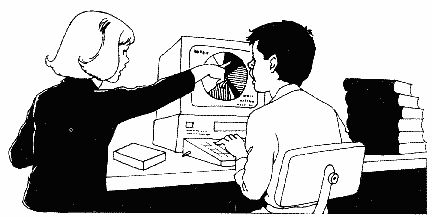
What is changing in our society so rapidly? Computers and their applications. Go to any office and you will see bunches of the little devils. What is the main challenge in computer applications? The person with the need doesn't know computers and the person who knows computers doesn't understand the need. I know computers. I don't know art or music. Can I help an artist or musician who doesn't know computers with his application? Not very well. Can I help an insurance salesman manage his business? Not very well. I can develop processes for my own applications, but without learning a user's needs, I can't help them with theirs. What is needed is for the user to learn computers themselves. This is hard...
Computers are not easy to comprehend. Reading isn't easy either, but it is such a valuable tool everyone has agreed to spend the effort to teach reading in school to every student. This commitment to reading (and writing) was made over generations of experience. Reading was a clerical art for hundreds of years, but slowly, the general population developed a need for reading as a communications tool. The educational institutions were one of the first to be 100% literate and it is now accepted as a necessity. Computers, on the other hand, didn't develop over many generations - they exploded on society in less than one! Not only is there no consensus of their value in the general population, but the primary educational institutions aren't even literate. This is not good. You already can't function in business without computer skills of some sort. Computers will be necessary in day-to-day life in increasing frequency regardless of our educational policy. People can still get along as illiterates, and non-drivers, but only with difficulty. The same holds for computers...
So, why don't we adopt a comprehensive and effective computer education curriculum in our schools so that future generations will have the basic skills they will need to be productive members of society? Well,,, we don't have a plan... We can't agree on the form or function of such a program. We don't have enough educators familiar with computers to generate support for a program. We don't have a general population of users who can lobby for a plan. Most important - we don't have the money to fund implementation of such a plan. Nobody to pay for a car, nobody to drive it and no place to go in it.
Sounds kind of hopeless, doesn't it? Am I writing all this just to point out the problem? No - I think there is a solution. More specifically, there is a direction that we need to move in to get started on the solution. We have to minimize the costs of such a program. We also need to allocate more time in the school day to the computer and integrate it into the educational process itself. Reading, writing and arithmetic should be taught on a computer when it is more effective to do so. If one thing hasn't improved in the educational system over the years, it's the efficiency of the teacher. One teacher, 30 kids. No productivity increase at all in the last 50 years. If we built cars like that, they would cost $50,000 each by now! We need to teach computer concepts to the kids, not software. Learning WordPerfect 5.2 under DOS is of little value to someone when it will be obsolete by the time they actually get in an office to use it. The teachers themselves must not only be computer literate, but they must understand the underlying processes in the computer... All of these avenues should be pursued, but you must start with costs or you won't get anywhere.
How do we minimize costs? Let's look at what costs are made of...
The cost of software: In a project of this magnitude, software should be developed in house or under contract for use in all schools. There is no need to use industry standard software. In fact, the use of commercial software is a major operational problem. Updates for such programs are produced according to market forces related to business needs, not educational utility. Features are designed into such products at a cost to every user that will have no classroom value. In addition, the advantage accrued to an educational supplier in the marketplace (everyone learns Lotus in school... ) would cause tremendous marketing and political pressures for the school systems. It will also be necessary for all schools to adopt the same software in order to benefit from economies of scale and to provide transferring students continuity. Bottom line: schools as a group should develop their own generic software that will be universally adopted.
Hardware costs: The cost of hardware is dependent on the useful life of the unit and it's capabilities. As in the case of software, the schools need to design their own proprietary hardware, much for the same reasons. The memory and processing requirements for a universal educational system need not be more than 1 megabyte on a 5 MIPS processor and, with the exception of the keyboard, the system should last a generation. Since the schools control both the hardware and software, they can be optimized for least cost and highest utility independent of market forces in the commercial world. Hundreds of thousands of identical systems would lead to highly integrated and lowest cost implementations.
Teaching material costs: The last requirement is for books, lesson plans and manuals for all these systems. This is another area where it has to be home grown. Since this is a custom design, you get to write the books, too.
Sounds easy, doesn't it? Well, maybe not too easy... Let's simplify it some. The hard part is getting started - lots of politics on specifications - lots of research and development costs - lots of time to get it done - why not just buy something already done? The whole banana... Hardware, software, and teaching materials. Buy the Atari 8bits! Buy the technology and rights from Atari. Buy all the software licenses you can find. Buy all the publishing rights you can find. (Kids and the Atari is a great book!) Buy the 65816 from WDC. Get the DOS, the OS, everything! That would cost you almost nothing and it's all done for you. Sure, you would upgrade and refine the systems hardware and software, but it would be a good starting point for the time being. The 8-bits are very simple compared to a newer system. They would be dirt cheap to manufacture in quantity and they lend themselves well to upgrades. The 65816 has plenty of power at higher clock speeds and has a very small die size (making it cheap to manufacture). Compared to an XT with a monochrome screen, the Atari has color, sound and software more appropriate for an educational mission. To be fair, the C64 and Apple II could also be candidates for a bootstrap system since they both have no commercial value with well developed hardware and software, but this is an Atari Classics article....
I can't imagine any other path to take that would result in the kids of today learning what is on a diskette, how a computer is programmed, I/O basics and system architecture in their classroom. These are the tools they will need to really use a computer in their life. Like the three Rs, it gets more difficult as you get older - kids need to learn it early in life or do without. They certainly won't learn it on an IBM XT from an untrained teacher who spends an hour per week on the computer with the kids. The program certainly won't be developed by educators who have not learned those skills themselves. A public that understands nothing about computers will not petition for a new educational process. I guess that just leaves us computer types...