
Closing
Up Shop
by Ben Poehland, AC
Managing Editor
A Promise Is A Promise
In my February '94 editorial, I stated that AC, unlike other Atari publications in the past, intended to compensate its readers for the unused portions of their subscriptions as we bring this unusual experiment to a close. At the time I made that commitment I had a gut feeling it would be one of those things that's easier said than done. I was right.
Working out a policy to treat our loyal readers as fairly as possible within the limits imposed by cost was a thorny dilemma. A lot of time was spent consulting with some of the AC Staff, the postal authorities, and especially our publisher to figure out how to handle the situation. For better or worse, I finally arrived at a set of policies to cover all contingencies and still keep our objective in focus.
That objective is to wind down this operation with as little financial burden to our readers as possible, and to be as fair about it as we can within the constraints of cost. There are some broad philosophical concepts I employed to guide the formulation of policies for issuing refunds and closing up shop. I'll share these with you, so you'll get a feel for the complexity of the problem I faced and know what reasoning went into the policies Unicorn and I finally agreed upon.
General Principles
When dealing with any organization whose resources are limited and whose services are needed by many, I followed the principle that those whose demands are least should be satisfied first, for in this manner the greatest number of people will be satisfied. Application of this principle to AC resulted in a prioritization of subscriptions into two broad classifications: those inside the USA and those outside the USA. American subscribers constitute 85% of ACs reader base, an overwhelming majority. Overhead costs for issuing refunds to those readers are also the lowest. Consequently, American readers (subject to a cost cutoff explained below), are awarded highest priority in the issuing of refunds.
Of the remaining 15% of our paid subscriber base, roughly 5% are Canadian while the other 10% originate from a variety of countries scattered all around the globe. By taking advantage of the Canadian banking system's liberal policies in the treatment of US funds, the issuance of refunds to Canadian subscribers ends up being only slightly more burdensome than refunds made to American subscribers. Consequently Canadian readers are awarded the middle level of priority for issuance of refunds. These first two categories of priority thus provide for 90% of our readers.
The final 10% of our readers who are outside North America are regrettably assigned lowest priority. They constitute a small fraction of our readers, and reimbursement costs to them are the highest. Most of these subscribers are in Britain and Europe, plus a few more in the Pacific (Australia and New Zealand). Whether or not these subscribers receive a refund will depend upon a variety of factors, the most important of which is the method by which they originally paid for their subscription. Credit card subscribers will be assigned a higher priority within this group than those who paid by bank draft or money order.
Very broadly, the prioritization of subscriptions as described above, in concert with the policies already in effect (as announced in my editorial in the February '94 AC) is envisioned to produce the following results. A small percentage of our subscribers, about 10%, (labels bearing 0294), will receive an extra magazine they didn't pay for. Another small group, about 10-15% of our subscribers, will lose a small amount of money. The amount will vary from about $5.00 up to about $12.00, depending upon the classification of their subscription. And finally, the great majority of readers, 75-80%, will receive a full refund and break even. Although there are bound to be a few cases of inequity, overall things should balance out to neutral. That's assuming, of course, that the magazine's financial assets are sufficient to cover all categories of refunds.
No Guarantees
At the moment I honestly don't know ACs exact financial status. Nor is it possible to determine what the magazine's financial status will be until we actually cease publication. So there's no guarantee we'll be able to issue refunds to everyone who qualifies for one.
At the time of this writing (early April), AC is still a fully functional business enterprise. Although its income has dwindled drastically in 1994, there is still some income (mostly from advertising revenue). And of course we have yet to pay the full production expenses for the publication of this final issue. Since our final income hasn't yet been tallied, and our final production expenses haven't yet been paid, we don't know exactly how large will be the remaining pool of funds from which reimbursements will be made. And the biggest unknown of all is what the sum total of all the refunds will add up to.
In short, the actual processing of refunds is something that will play out as we go. We'll simply commence issuing refunds to everyone who qualifies for one, until everyone is paid or the money runs out-whichever happens first. The order in which refunds are made will be determined by the general priorities described above. My commitment to issue refunds is based on estimates of ACs financial condition furnished me by Unicorn Publications. I know that substantial resources exist. What we can't predict is exactly how far those resources will stretch.
Cost Cutoffs
In discussing the cost of making refunds with our Publisher, it quickly became apparent there was a certain level of reimbursement below which it simply was not cost-efficient to issue a payment, due to the overhead cost involved. The cutoff figure we agreed upon was $5.00. What this means is, if the calculated value of your refund amounts to less than $5.00, you won't receive a refund. For non-USA subscribers, this cutoff is higher due to the extra expenses of currency conversion, credit card transaction fees, and money order fees. A cost cutoff will be applied to all classifications of subscription refunds.
At first glance the imposition of a cost cutoff may seem unfair. In practice, however, it will only affect a relatively small number of subscribers. By applying the cutoff we are ensuring a larger pool of funds available to the many who are due substantial amounts of money, at the expense of a few who are due trivial sums at high overhead cost. It is consistent with the general principle of conserving our resources to ensure most of the money we send out ends up in the hands of subscribers instead of bank fees or postal agencies.
Practically speaking, application of the cost cutoff means that if the expiration on your mailing label is 0694 (and you didn't subscribe to the Disk), you won't get a refund. You might get a refund if you subscribed to the disk or your label expiration reads 0894. If your label reads 1094 or 1294 (the majority of readers), you'll almost surely receive a refund-subject to the limits of the available pool of reimbursement funds. And of course, labels bearing 0294 or 0494 are subscriptions that have already expired, so those readers won't even be considered for a refund.
Are you confused yet? Welcome to the club! If what I've presented thus far has made for difficult reading, be assured that making all these decisions and trying to describe it hasn't exactly been a picnic. Perhaps things will come into sharper focus when you see the detailed summary that follows.
Refunds In Detail
Prioritized classes of refunds and cost cutoffs are as follows:
A.) USA subscribers. Anyone who is due a refund of $5.00 or more will receive a check. If the amount of the refund totals less than $5.00, no refund will be issued. Class A subscriptions will be processed first.
B.) Canadian subscribers. Anyone who is due a refund of $8.00 or more will receive a check in U.S. funds. Most Canadian banks routinely handle drafts in US$ and typically charge $3.00 for currency conversion, which cost will be borne by the subscriber. If the amount of the refund totals less than $8.00, no refund will be issued.
C.) Non- North American subscribers who paid by credit card. Anyone who is due a refund of $10 or more will have a credit issued to their charge account, provided the account is still current. A $2.00 transaction fee will be charged by the publisher, to be borne by the subscriber. Currency conversion fees charged by the credit card issuer will also be borne by the subscriber. If the charge account has expired, AC will attempt to reimburse the reader according to classification D below. If the amount of the refund totals less than $10, no refund will be issued.
D.) Non-North American subscribers who paid by bank draft or IMO. Included in this category also are readers whose credit account has expired since they subscribed. Anyone who is due a refund of $12.50 or more will receive a refund via International Postal Money Order, the $7.50 IPMO fee to be borne by the subscriber. If the amount of the refund totals less than $12.50, no refund will be issued. Class D subscriptions will be processed last.
Logistics
Atari Classics will bear the overhead costs of check processing, postage and paper. We presently anticipate issuing around 300 refunds. Credit card transactions and IPMO payments will originate from Unicorn Publications in Michigan, while the actual mailout of credit slips and and checks will be done from my Pennsylvania location from bulk shipments of same sent to me by our publisher. The internal logistics are necessarily clumsy because the magazine's distribution and accounting functions aren't all under one roof, so they've never been integrated.
Who will determine your refund eligibility and amount? I will. Once the distribution of this final issue is completed, I'll be combing the subscriber list one entry at a time, applying the policies outlined above, and submitting lists of names and amounts to our Publisher. Within each category, refunds will be issued in alphabetical order by last name. No one associated with the magazine Staff, including me, will receive preferential treatment. If the cash flow runs dry just as I get to the name of some Editor or Columnist or whatever, tough krinkles guys. As subscribers we all stand equal.
Having never done anything like this before, I have no idea how long the process will take. I'd like to see all the magazine's accounts settled by August 1, 1994, but that might be wishful thinking. All inquiries from anxious readers will be ignored; I won't have time to answer volumes of frivolous mail and work on refunds as well. I think it's safe to say that if you haven't received a refund by September 1994, you aren't going to get one. No amount of desperate begging/pleading will help: our refund policies are carved in stone.
For those of you who subscribed to AC late in its existence and don't have a full complement of issues, I'll continue to make Back Issues of magazine and Disk available as long as my stock permits. Please refer to the masthead on page 3 for policies relating to the purchase of Back Issues. I especially caution readers NOT to request their refunds in the equivalent value of Back Issues. Refund payments are handled by Unicorn Publications, while Back Issue sales are processed personally by me-and ne'er the twain shall meet.
What Now?
On page 15 of this issue you'll find an enticing editorial by Jim Hood detailing the intention of our California-based colleagues to keep the Atari Classics tradition alive. I still can't decide if Jim Hood and Bob Woolley are the bravest fellows I've ever met, or if they simply escaped from the same cell at the local asylum and haven't been rounded up yet. (As regards the latter possibility, I should perhaps not speak so boldly, as there have been enquiries about my own sanity of late.)
No matter, as long as there is any kind of effort whatever, I'll certainly support it. I'm favorably impressed with the flavor of what I see on pages 15-18. I'll not wait to receive my own refund as Jim suggests, but will forthwith send my new subscription to California as soon as I receive my copy of the April '94 AC. And I encourage all of you to do the same if you wish to see our community, our market, and the usefulness of our machines preserved. I do honestly believe this will be our last stand, our final opportunity for existence as a recognizable entity. If the California effort fails, you might as well pack away your 8-bit and start reading up on MS-DOS.
Mainstream Perspectives
The direction of the mainstream computer market is heavily slanted toward the "messy-DOS" machines anyway, and old PC/XT/AT machines are to be had almost for the asking (I've acquired a closetfull of them, 9 at last count). For anyone who remembers the "computer wars" of 1984, when the giants of the home computer industry battled for supremacy, it's now clear the Intel/Microsoft architecture has won. Even mighty Apple-whose founders trace their beginnings to the old Atari under Nolan Bushnell-is straining to maintain its 10% niche of the mainstream market. And Atari Corp., despite the introduction of XL's, XE's, ST's, STe's, Megas, Falcons, Lynxes, and Jaguars, doesn't even make a dent in the mainstream computer world. Or the videogame world any more either, for that matter.
After 10 years of using my trusty 800XL, I find myself sucked irresistably toward the mainstream computing world. Partly this is due to the demands of my job: nobody with an active career in science can afford to ignore trends in computing technology. This attraction has always existed, yet until lately I've successfully resisted it. It isn't so much that the lure of the PC/Mac has grown stronger; rather, it's the growing inability of my trusty 800XL to serve my changing needs, which are all software-driven.
I'm much impressed with Dave Richardson's rendering of laser-generated Daisy-Dot 3 output in this issue. It's very reassuring to know there's at least one 8 bit DTP program that can benefit from laser printing technology without modification. However, I fear Dave's success at coupling DD-3 to a laser printer is more the exception than the rule.
As I read over Jeff McWilliams' "Moonlight Workshop" column in this issue, it struck me that Jeff was once again telepathically tuning-in to my private thoughts. The tone of frustration implicit in his experience with the Epson Stylus 800 is a microcosm of a larger problem that, if not soon remedied, spells final doom for us devotees of the classic Atari. The problem is lack of software, especially productivity-oriented material capable of interfacing with today's sophisticated hardware technology.
Software: The Final Frontier
The actual "machine" we call a computer is purely a hardware contrivance. But the sad fact is, in the computer world hardware no longer counts for much. The difference between a computer that gets used and one that doesn't is the availability of software. Folks, take a look around. Shareware and PD offerings notwithstanding, there just isn't enough input on the software end of our market to keep our hardware viable. Advances in hardware technology continue to occur at a dizzying pace. As Dave Richardson and Jeff McWilliams have demonstrated, our Classic-8's are capable of utilizing at least some of this advanced technology, if only someone will write the software.
Our existing software base is just plain decrepit. Much of the commercial software available for our machines is woefully outdated and needs to be de-bugged or rewritten to take advantage of newer hardware and more powerful DOS's. (The recent effort of Fine Tooned Engineering to spruce up the code in some of the old OSS/ICD products is a step in the right direction.) Perhaps the old stuff is sufficient for some users, but for those of us whose needs are still evolving, hanging onto the beloved Classic 8-bit is becoming a process of slow strangulation.
A case in point is software for generating camera-ready electronic diagrams (such as appears in Paul Alhart's "A-T-A-R-I" column elsewhere in this issue). With today's 24-pin, inkjet, and laser printers, an XL/ XE machine with expanded memory is entirely capable of generating satisfactory schematics. Instead, what do we have? Graphic Master, Circuit Database, and Schematic Designer: all of them outdated, amateurish, inadequate, and unuseable for any serious application. I don't mean to scandalize anyone, but even Bob Woolley (as fanatical a devotee of the Classic-8 as I am), used Schema on an IBM to generate the schematics for his December TTL video upgrade article. If Bob could have generated schematics of equivalent quality on his beloved 1200XL, you can bet he would have done it. But there just isn't a Schema for the XL.
The cruelest hoax I ever experienced was Graphic Master's claim to be able to produce "chemistry symbols". The first time I used the program it became painfully obvious no one at DataSoft had ever bothered to ask a real chemist what was required of such software (the chemistry symbol library was a joke). If they had, they'd today be competing with programs like ChemDraw for the Macintosh, which sells for $900 a copy. The graphic below, which I created in ten minutes on a $3,000 Mac IIci with a $2,000 Hewlett-Packard laser printer, could have been rendered reasonably well on my 1-meg 800XL with a 24-pin printer if the software existed. Sadly, my employer forced me to take my 800XL home after five good years of service because I couldn't draw chemical structures with it. It was software, not hardware, that turned my 800 XL out to pasture.
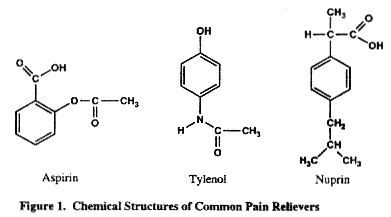
The Mars-8 product now in development at Fine Tooned Engineering is rumored to provide a staggering 4-megs of expanded memory. But, what software will utilize it? Atari gave us a nice 80-column hardware upgrade, the XEP80, but you don't even need all the fingers of one hand to count the software applications written for it (and none of those are graphics programs). The most technically advanced computer hardware is so much worthless junk without correspondingly powerful software to complement it.
800XL Or IBM?
I walk into one of the many warehouse-type computer stores springing up all over my area and see endless aisles of software for the PC, including some very attractive graphics packages. A day will come when I'll find PC programs that'll permit me to draw electronic diagrams and chemical structures. There being already tons of programs for the IBM to do the routine stuff I'm already doing with my 800XL (wordprocessing, telecommunications, and databases), a few more quick PC software purchases will complete the obsolescence of my faithful 8-bit.
That day is coming; I'm not sure when. For the present I'll continue to pound this same keyboard I've beaten to death for the past 10 years (the textured surface on the keys is now worn completely smooth) on an 800XL which is as familiar to me- inside and out- as my favorite pair of old shoes. And I'll continue to support Atari Classics for as long as it, and I, occupy the same sphere of interest.
One Last Salute
Before signing off this final missive in my capacity as Managing Editor of the AC Experiment, I'm compelled to pay homage to the Columnists, Editors, Reviewers, Authors, and Subscribers who all contributed to the enviable tradition established by this publication during its all-too-brief existence. Amateurs we may be, but I'm satisfied we gave a good account of ourselves. We sail forward into an uncertain future secure in the knowledge we did our best.
