
Games
That Teach
John Blackford, Assistant Features Editor
That Teach
John Blackford, Assistant Features Editor
Ever since computers were first pieced together out of radio tubes, their potential as teaching machines has fascinated educators. One of the first ideas was to let computers drill students on important skills. Later, programmers enlivened these practice sessions with games and arcade-type action. Today, innovative teachers and game designers are working to create new software and develop teaching methods that make learning itself part of the game. Some of these new products and ideas are finding their way into the home - via the personal computer.
Walk into any video arcade and you'll see teenagers in a twilight world, hunched over machines about the size of small refrigerators. Seemingly oblivious to the beeps and whistles that fill the air, they concentrate on the small screen. They can play for hours. This scene is noticed by some educators, who would like to tap that intensity for the learning process.
Some of them have. Educational games have acquired a reputation for being rather dull, and many are. But that is changing. Publishers of educational material are developing computer programs; makers of computer games are diversifying into educational products; and fledgling school computer ventures are maturing into active resource centers and using the best software available (see "Computers In School: New Approaches," in this issue).
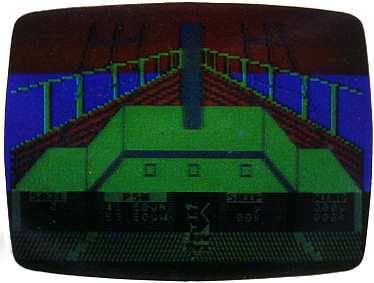
The title screen of the educational game "Clipper."
What Makes It Educational?
Almost any activity involves some learning. It wouldn't hold anyone's interest long if it didn't. For an arcade classic to enthrall a player for hours at a time, perhaps week after week, there must be a progressive mastery of the game's secrets. Experts at a game like Pac-Man say they've memorized several complex patterns of movement in order to "beat" the game. But you wouldn't expect to find "Theory of Pac-Man" being taught in schools. So what does set an educational game apart from any other kind?
First, it must have a clear educational goal. John Victor, whose Program Design, Inc. (PDI) produces such programs as Clipper: Around the Horn in 1890, says, "When we do an educational product, we sit down and define a set of educational parameters with measurable results." Then, a program can be tested in the classroom to see how well it meets its objectives. Before they started on software, PDI designed programmed instructions for educational groups, but Victor believes that market pressures are going to encourage firms new to the field to introduce educational games. He feels it's important for the purchaser to consider the educational value of a product.
Furthermore, just the educational value of software has itself become a selling point for computer manufacturers and retailers, according to Doug Carlston, president of Brøderbund Software. Although educational software still sells more slowly than games, Carlston says that if the purchaser becomes convinced of a computer's educational potential, a sale is much more likely.
Another important factor in determining a game's educational value is whether the game is related to the educational goal. Some games take what might be termed the Mary Poppins approach to learning, making everything fun for children.
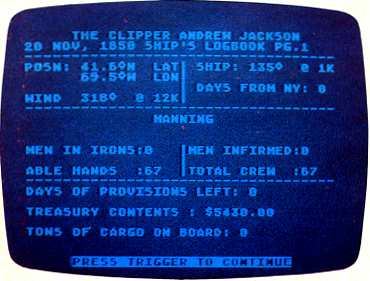
A logbook for the clipper ship The Andrew Jackson.
Games of this type start with an educational goal, perhaps a multiplication drill. To make the work seem more palatable to children, the pro grammer may add a game aspect. For example, if a child gets a correct answer, he or she can then shoot an approaching alien. But here the game is unrelated to whatever is being taught. Dr. Thomas Malone, who has studied several computer games at the Xerox Palo Alto Research Center, suggests this possibly negative effect. In an interview in the April 1983 Classroom Computer News, Malone suggests that if the game aspect is available only as a reward for getting a correct answer, the student's motivation can actually decrease. He is learning that arithmetic is an unenjoyable activity.
According to Malone, games that make the learning aspect part of the fun are more effective. He calls these intrinsically motivating games. In one that he's studied, Darts, you try to pop balloons by guessing where they are located on the screen. If you guess too high, an arrow shoots above the balloon. Too low, and it shoots below - so the game reinforces the concept being taught. Such games impose an extra burden on the game designer. While various number concepts - addition, subtraction, fractions - can easily be incorporated, a subject such as spelling or word use would impose different requirements.
Preschoolers
Surprisingly, preschoolers seem not to need motivation from game playing during learning. Their enthusiasm for computers runs high, and a well-produced program for drill and practice meets the youngsters' approval all by itself, according to programmer Bruce Mitchell. He created a line of such programs for preschool through second grade, distributed by the Programmer's Institute. Mitchell is not sold on the fun-and-games approach to programming: "I am an absolute firm believer in the idea that educational programs should be educational - not games."
What he strives for is user-friendliness - anticipating any problem the user could have and building the solution into the program. Another thing important to Mitchell is consistency. Every program he's written uses identical command procedures, so a child moving from one to another doesn't have to learn new instructions.
And finally, Mitchell feels that good documentation is important. That means that the child - or the teacher - should be able to learn about the program by reading the literature that accompanies the product. If these criteria are met, and the skills being taught are appropriate to the child's level of development, then the program will be useful.
"But I don't believe the computer should be the primary tool to teach a concept," adds Mitchell. "It should be used to help teach the idea, rather than do it all."
For older kids, Mitchell sees computer literacy and programming skills as fundamental. "The creative thinking that permits you to write pro grams is something you can use throughout life," he says.
Simulations
At the other end of the spectrum from drill and practice are simulation games. They engage the user in a real-life situation - whether it's trying to cross the United States in a covered wagon or running a profitable lemonade stand. Such games are powerful because they not only teach, but also allow the user to make choices within a complex, detailed scenario while observing the consequences of various decisions.
For years educators have used such games as Oregon, Lemonade, and Cartels and Cutthroats to provide an extra dimension to their computer instruction. In Oregon, you join the westward migration, avoiding Indians, thirst, and starvation in an effort to reach new territory. Lemonade simulates a small business and the player can see the effects of reducing an advertising budget, raising prices, and fighting the weather while trying to stay in the black in the business of lemonade sales. Cartels is about business on a grand scale; the player is in charge of a multimillion-dollar manufacturing plant.
One professional software house which has incorporated educational values into games is Spinnaker Software. For preschoolers, games such as Story Machine and Facemaker support creative efforts by the child. Adventure games for older children encourage problem solving. In Snooper Troops, for instance, the user tries to solve a mystery. To be successful, you must learn as you proceed, experimenting with the SnoopMobile, a wrist radio, and a camera to discover and use clues.
Another adventure, In Search of the Most Amazing Thing, involves traveling through 20 different countries. When you pass through one, you must learn the language, the money system, and some of the local customs. "It's learning without making you feel you are being educated," says Nancy Evans, an editor at Spinnaker. "If you get something wrong, the game is not over."
The adventures hone problem-solving skills indirectly, making them part of the excitement of playing. Learning becomes a natural part of the action. At first, children don't take any notes when playing a game like Snooper Troops, according to Spinnaker's chairman, Bill Bowman. Then they begin to jot things down in haphazard fashion. Finally, he says, "kids begin taking notes in a structured way." No one tells them to; it just makes the player more successful.
Into The Home
These games are attractive to many educators, but school budgets are tight. In many cases, school administrators are unsure of what to buy. New software must first be reviewed, sometimes at the state level, and approval can take months, even years.
Often, the only way a teacher can get a computer venture under way is to rely on individual initiative. It's not uncommon for a teacher to use personal funds to purchase a computer for students. In fact, says Bowman, nearly all of Spinnaker's sales to educational groups are paid for by individuals - evidence to him that teachers are buying the products with their own money.
"They realize what the computer can do," he adds. "But schools are too slow and too bureaucratic. We feel that the revolution in educational computing will occur in the home."
To tap this market, Spinnaker is emphasizing cartridge software. People who don't have disk drives can acquire the games without having to make a substantial investment. Other manufacturers are undertaking similar efforts. They are stressing both educational quality and fun. And lest parents forget, producers are reminding them that students who learn at home have an edge at school. "When a child is exposed to software that teaches at home, chances for high success in school are greatly improved," according to Dr. Larry Lowery.
Lowery, who lectures on courseware evaluation at the University of California, Berkeley, created an extensive manual that is used by Soft Kat's Educational Computer Centers. To help potential purchasers examine educational software before they buy, Soft-Kat has established over 300 centers where parents, teachers, and children can select programs and try them out.
Computers Vs. Game Machines
Activity such as this suggests that there is real interest in the home educational market on the part of software producers. In fact, both PDI's John Victor and Brøderbund's Doug Carlston see a rapidly growing market there. Part of the reason is that home users are beginning to purchase almost as many computers as video games. Experts in the computer industry had thought that it would be years before home computers began to sell in such quantities. However, intense price cutting among manufacturers has dropped the price of some computers below that of video games. It is now quite possible that computers will begin outselling game machines as early as next year.
This could make educational games the next growth area in the computer business. As more manufacturers get into "eduware" and computer users look for software variety, the field could blossom. Competition may be tough, though. As Victor notes, "Parents don't like wasting money. The people who put up the bucks really want to be sure they get results.